Monday, February 24, 2014

The Negative Enigma

So two things happened since my last post -


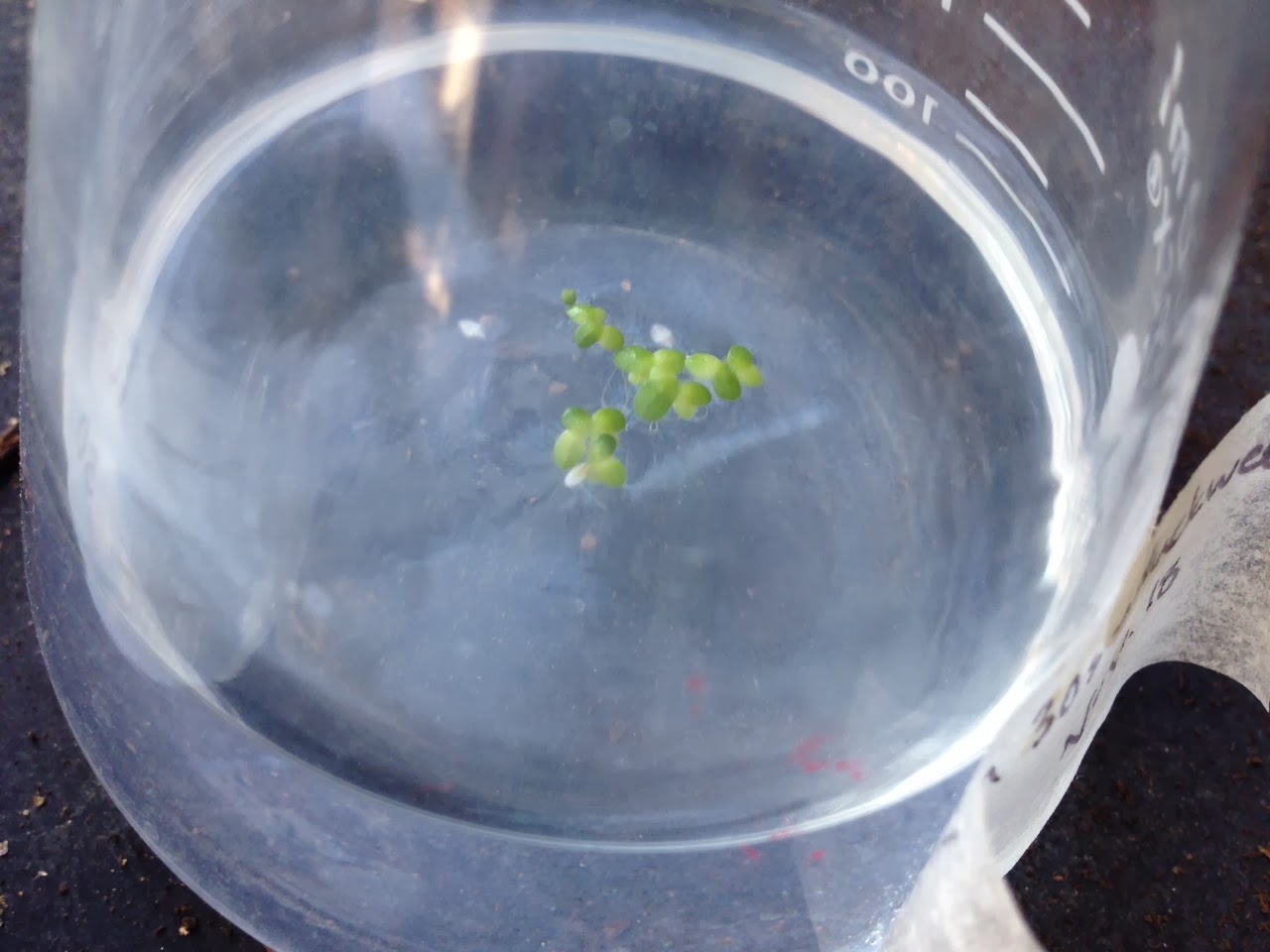
  • My duckweed cultures continued to grow nicely, especially the 15s clones, which have already filled the media's surface: 


  • I ran the starch assay with this sample.
I didn't have to run the calculations very far to find, to my crushing disappointment, that the purported percent starch of this sample was -0.18% LESS than the percent starch of the reagent blank. 
...Physically, how is this possible?
It just does not make sense. After initial discussions with Dr. B we think it may be due to incomplete extraction in the ethanol-centrifugation step, but we'll have to further reexamine the procedure to find out. 
Personally, I think the step where it says "discard supernatant" is somewhat sketchy - it could have been that residual amounts of starch that matter just enough for a small 56 mg sample as this were discarded in the supernatant.

If this were so, we would have to pellet the tubes longer and faster.

Another challenge we face in the near future is the fact that other than the 15s and 60s duckweed samples, we barely have enough duckweed fronds to grind up to meet the recommended 50 mg sample weight. For now, we're allowing the plants to grow indoors, where it's warmer. Later, I plan on putting them back into the greenhouse once spring starts getting into the swing of things.


Sunday, February 9, 2014

3...2...1

So we're starting sample assays this week and this time it is going to be the real deal! I still have to make adjustments to the procedure (dry duckweed fronds, standardizing centrifugation time, ethanol amounts, etc.) but other than that I plan on starting Tuesday - we'll see how it goes!

Tuesday, January 28, 2014

Grow grow grow!

So I checked up on my plants recently and was very pleased to find that they have been growing quite nicely since my last update:

15s population

30s 


60s and 90s

The time is ripe for assays!

I'm nearly out of reagents from my first kit, so I ordered the second kit last week, and hopefully, the package will be coming soon. (But evidently, not soon enough!)

Monday, January 20, 2014

Control Conundrums

Okay so as it turns out, the past two weeks I've been busy standardizing my procedure still, making sure that a) my experimental procedure is repeatable b) my procedure actually works.

I repeated the cornstarch control experiment a second time:

As you can see, this trendline, compared to that of the previous control graph, differs markedly... THE SLOPE IS NEGATIVE, which doesn't make any sense! #whyisthismylife

When I first finished my calculations, I had a mini panic-attack - I checked and rechecked my number chugging, and found nothing wrong. In the midst of my alarm, a sudden brainwave - I had my lab notebook!


So, I keep this marble lab notebook in the prep room over the course of my experiment where I attempt to record in as much detail as possible my procedures - what I actually carried out as opposed to what I typed up to carry out. If I had many any changes to the procedure that might have accounted for this drastic difference in data trends, this was the place where I would have written it down.

I ran and grabbed my notebook, flipped through the pages (some of them stained with mystery liquids), and Voila! It all started coming back to me.

In this particular procedure, I had massed the sample weights with a different method - rather than using the weigh paper method, I first tared the test tubes themselves, then measured out the correct amount of cornstarch into the tubes and massed that. Because it was difficult to add and subtract precise amounts of cornstarch, I had to redo one massing. I had to wash out the tube, and so there were minute droplets of water left over that never completely dried out - this would have made a difference, possibly substantial, in the actual and measured mass of the cornstarch samples.

As if that one change were not enough, because of time constraints in this round (last time, I had done a good two-thirds of the procedure afterschool, whereas this time, I had to cram as much as I could within my 1 hour period in school), I paused the experiment just before proceeding with the starch digestion (right after boiling the alpha-amylase reaction for 5 minutes). Perhaps keeping the reaction in the refrigerator overnight before proceeding directly to the next step might have had some bearing on the differences in the data. 


Friday, January 3, 2014

So Hyped!

So I'm back from my winter break, and next week, I will be beginning the first round of my actual experiments in assaying my duckweed samples. I will have to grind up representative duckweed fronds to carry the procedure out as I've been doing for the past few weeks...super excited!

Sunday, December 15, 2013

Calculation Results

Alright, so down to some number-crunching!

The magic formula I used for calculating percent starch was:

% Starch = [(∆Atest )(900) ]/  [(∆Astd)(sample weight in mg)]

(I won't bore you with details on where the 900 came from but it involves the multiplication of molecular weight of starch monomers, initial sample volumes from glucose sample volume assays, dilution factors, and whatnot.)

Okay. The values for the 1 mg sample, 5 mg sample, and 10 mg sample turned out to be 24.3%, 33.7%, and 56.7%.

Plotted on a graph, the relationship turns out to be somewhat linear, which is a good and expected:


Next week I will repeat the standardization experiment to make sure everything is correct (and to make sure it is repeatable), before moving on to the real samples.

Friday, December 13, 2013

Pink is My Favorite Color (Day 2 Standardization Continued)

Check out these beauts!

Fig. 1 (From left to right): Standard Blank, Standard, Reagent Blank, Cornstarch Samples "1", "5", "10"

The intensity of the pink color pictured above is proportional to the original glucose percentage. I got absorption readings of 0.02, 1.2, .185, .22, .41, and .95, respectively (at 540nm).

Also, this was my work area:

Fig. 2

...Cozy, no?
(That labeled bottle on the left is the sulfuric acid solution! And the paper on the right - that's my procedure bible.)

I'm going to take these measurements home and plug them into my calculations, and see what I'll get for the percent starch. 

This is so cool!!! :)